
“Stus saved me in captivity” — the story of Hospitaller Serhii Kovalov with callsign “Bison”
- Oleksiy

- Jan 6
- 14 min read
“Choosing to be Ukrainian”
The 1990s. Little Serhii is growing up, absorbing knowledge about the world, people, Soviet idols, and what those idols are capable of. His friend Nazar lends him "Kobzar" to read — a seed falls into fertile soil. He learns about the Lontskoho Prison and the fates of those left to rot there. This story was being written right here, just a few blocks from his native Sykhiv district. He remembers the day — August 24 — the whole building is buzzing and chanting: “Ukraine has gained independence!”
Life is not kind to the boy. A severe congenital heart defect can provoke clinical death at any moment. Serhii undergoes three complex surgeries. During one of them, an anesthesiologist’s mistake costs him two weeks in a coma.
Serhii earns a law degree but quickly grows bored with the profession. He switches to the construction sector, laying structured cable networks. Soon, he becomes the head of his own company. Business is going well — but a great calamity is brewing in the country.
November 30, 2013. That night becomes a turning point: the Maidan turns into the Revolution of Dignity. This event divides the life of Lviv resident Serhii into a clear “before” and “after.”
Alongside running his business, he becomes an active patriot: travels with volunteer battalions, engages in patriotic education of youth with the organization "Trukhanivska Sich", and supports the families of the Heroes of the Heavenly Hundred. He participates in Maidan-related hearings. Eventually, he devotes himself entirely to volunteering, closing his construction firm.
In 2018, Serhii Kovalov met Yana Zinkevych and joined the Hospitallers battalion. After completing a rotation, “Bison” undergoes full training only then. He goes on all rotations to the Mariupol direction, stationed at the “Murakha” position between Shyrokyne and Vodiane. At that time, Vodiane was considered the hottest spot along the entire line of contact.
“Bison” likes to stay on rotation for long periods. He lays a unique evacuation route through minefields to rescue the wounded and carefully protects this road, keeping it exclusively for evacuations across the local off-road terrain.

“A paramedic knows no fatigue when facing another’s pain”
Summer 2021, Vodiane. In the gray zone beyond the trench line — a wounded. “Bison” struggles to pull him out, but not immediately — 55 kilograms versus well over 100.
“I drag him on my back and pray, cry, laugh — and keep dragging, crawling on all fours. Thank God the grass was tall,” recalls “Bison.”
When enemy artillery opens fire, the entire defensive line rises to provide cover.
Serhii is deeply moved: “I’m a civilian. I’m not one of them. But I was overwhelmed by how much the guys cared about my life!”
He regularly risks his life in dangerous situations. He feels he must stay with the wounded.
“The eyes of women with infants from the Drama Theater are forever in my heart”
Winter 2021. “Bison” welcomes the New Year at his position. At Christmas, he manages to break away home — to his mother and son. And already on February 7, he returns. A war is approaching.
Events unfold rapidly: on February 10, the enemy launches a massive assault; by February 27, they retreat to Mariupol, first fortifying in Volonterske.
Marines establish a stabilization point in the maternity hospital in Volonterske. Women are evacuated, and the wounded are brought in. After stabilization, they are transported to the Mariupol hospital. In one of the hospital rooms, “Bison” finds a storage area full of baby boxes.
“I used to bring food to the Drama Theater and saw that women with children lacked everything — diapers, baby food. I loaded everything I could find, filled the entire vehicle with baby boxes,” recalls “Bison.” The women are delighted—the boxes contain everything an infant needs.
“Bison” delivers this aid to new mothers one day before Russia’s airstrike on the theater, which claimed the lives of hundreds.
The faces of those buried in a mass grave under concrete slabs remain with “Bison” forever.
“We had to get out before dawn, otherwise a massive airstrike would hit”
The road from Vodiane to Mariupol becomes a true ordeal. Enemy artillery relentlessly shells the village, and at the only exit — an unavoidable intersection — the occupiers have dropped a half-ton aerial bomb. The crater is as tall as a five-story building.
They set out at night, without a single headlight. Serhii is driving a Mitsubishi L200 with only the rear axle working. Inside the cab, besides him, is the Hospitallers crew: “Borysivna,” “Ptashka,” and “Dream,” while the truck bed is packed full of medical supplies.

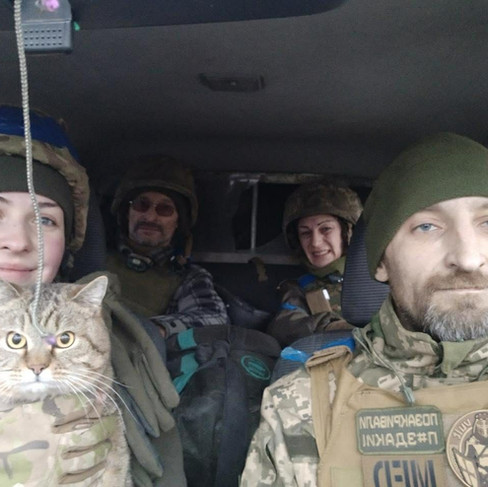


There is no road as such — under the wheels is a solid mess of stones and debris from destroyed houses. The overloaded trailer scrapes the ground, catching every pothole. To see anything at all in the pitch darkness, “Bison” briefly turns on a flashlight, covering it with his palm so the enemy won’t spot the light.
They cover those two kilometers in four hours.
“I knew we had to get out before dawn, otherwise we’d be hit by a massive airstrike.” He made it out.
“The blast wave threw us straight onto the wounded”
While on radio duty, “Bison” hears a desperate cry for help. Exiting the bunker, he sees a twenty-year-old driver — the only one from the crew left uninjured. Their vehicle has just been hit by an enemy missile. The consequences are catastrophic: the commander has lost both legs and an arm; another man has lost an arm; the mechanic has lost an arm and a leg.
They have to save the wounded under critical conditions. “Borysivna” kneels, trying to help one of them. “Bison” struggles to place another wounded man onto a stretcher. At that very moment, an enemy tank begins firing directly. Red-hot embers, pieces of metal, and burning slag fly around.
“The blast wave threw us straight onto the wounded. But it felt as if someone had covered us with an armored dome: everything within a meter radius was burning and exploding, and not a single scratch, not a single fragment touched us,” says “Bison.”
“With a bullet in his chest”
A mission to the Illich Steel Plant is planned, with vehicles clearly marked. The crew heads to the assembly point, where “Ptashka” is already at the stabilization post.
On the way, the vehicle is shot at. A burst hits the right side, completely destroying the engine compartment. One of the bullets pierces the vehicle’s armor and strikes “Bison” in the chest.
“The metal tip passed between the plate carrier and my body, entered the right side of my sternum, and pierced my lung,” Serhii states.
A few minutes later, another vehicle arrives. Serhii is evacuated under fire. Medics from the 36th Brigade apply an inclusive patch and transport him to a bunker. There, they administer tranexamic acid to stop the internal bleeding.
The pleural cavity is already filled with blood. There is no proper needle for drainage, so they install the largest catheter available — and it works.
“That bullet saved my life — and the life of the entire crew”
On April 12, the order is given to break through toward Zaporizhzhia. Those who wish may remain in Mariupol and make their way toward Azovstal.
The first attempt at a breakthrough on the night of April 12–13 fails. The first column is destroyed by Grad rocket fire. About 80% of the brigade attempts that fateful breakthrough. But “Bison” has no vehicle.
The Hospitallers are given an armored cash-in-transit vehicle. “Bison” cuts an opening in it with an angle grinder so stretchers can be loaded. It is in this modified vehicle that he rides — until he is wounded.
“If I had gone on that breakthrough, the entire crew and I would have been killed. That bullet saved my life. And not only mine,” Serhii says.

“I had already pulled the pin to blow myself up… When the saving fog fell”
The risk of heading to Azovstal is enormous, but staying at the Illich Plant is no longer possible. All the wounded are loaded, but the drivers don’t know where to go — they need an escort. Finally, they set off, but not for long: the vehicle falls into a massive crater from an aerial bomb. They cannot continue.
“The whole column moves on, we stay at Illich,” says "Bison".
Dawn breaks. They try to establish communication, but the radios don’t reach. Luckily, in a neighboring hangar, they find an abandoned Kozak armored vehicle — with damaged wheels, but equipped with a powerful “Lybid” radio station. They manage to establish contact.
“There are vehicles in the hangar — take whichever you want, attach white flags, and head toward Zaporizhzhia. Surrender or break through. No one from Azovstal will come back for you,” “Bison” quotes the message received.
And adds: “And then I realized that for me, as a volunteer, this option didn’t work. I had already pulled the grenade, already wanted to blow myself up. The girls were pressed close the same way. I had already pulled the pin.”
But the radio crackles. “Rom” and “Palych,” at their own risk, move out. They gather about 40 people, in addition to the wounded, and load them into the vehicle. With broken hydraulics and damaged wheels on the 12-ton vehicle, four of them turn the steering wheel together to navigate around bombed pipes and craters. The escape seems endless.
“Broad daylight, spring, the sun is shining. And then fog descends. And without a single shot, we enter the plant’s territory,” recalls “Bison.”
“Today marks one month since my wife died”
They entered Azovstal on April 15. They barely manage to settle in when the first combat alert sounds — the enemy has broken through. Several enemy APCs penetrate the plant’s territory. They manage to push them back. But hell still begins: the enemy realizes there are countless ambush points. Many wounded, constant shortages of medical supplies, and a dire food situation.
Early May. “Rom” enters the bunker and suggests going up to his vehicle.
“Rom,” from the 36th Brigade, after losing his wife — killed when a FAB bomb pierced the bunker — seems to be searching for death himself. He goes everywhere with little chance of return. He pulls out the wounded and retrieves the bodies of the dead. And comes back.
“It felt like his wife was shielding him with her wings — along with everyone who was there,” says Bison.
“Rom” never sleeps in the bunker. He always sleeps in his vehicle, parked in a bombed hangar. After an airstrike, the hangar’s ceiling collapsed, and a concrete slab fell. It was falling onto the vehicle but split in half directly above it, forming a kind of shelter. He sleeps there—the vehicle is stationary because the area is controlled by the enemy.
Inside the vehicle, “Rom” takes out a can of sardines and a 100-gram measuring cup of alcohol.
“Today marks one month since my wife died. Let’s remember her,” he says.
They divide the sardines among three.
After the memorial, “Rom” unexpectedly suggests going down to the bunker — somewhere he usually can’t be persuaded to go. They pass through the bombed hangar into the next, relatively intact one, where rows of metal boxes with electronics stand. “Bison” follows “Rom,” with “Borysivna” behind them.
Suddenly, “Rom” stops, turns around, and extends his hand with the command: “Bison, stop!”
“I run chest-first into his hand and see what’s happening behind his back. A missile flies into the hangar, blasts out part of the wall, and a chunk of concrete about a meter and a half in diameter flies through and smashes all those metal boxes — crushing the exact spot where we were supposed to pass a second later. It would have ground us into dust,” Serhii recalls.
“Rom” freezes in the dust amid the fire, staring into nothingness with glassy eyes. A moment later, shocked by their survival, “Bison” and “Borysivna” descend after him, making their way over sharp debris deep into the bunker.


“What I took out of Olenivka was the most precious thing — a dream”
“For some time, we were already being morally and psychologically prepared for captivity,” “Bison” believes.
May. Columns of trucks carrying those who, by order of command, exited Azovstal into “honorable captivity” move toward occupied Olenivka.
They are met there by Russia’s Federal Penitentiary Service (FSIN), the FSB, and special forces — well-equipped, in helmets and body armor, armed with batons.
Lack of food and water, unsanitary conditions, and above all — an acute shortage of medicine. In a barrack designed for 200 people, more than 750 prisoners are held for over a week. Later, they are sorted and transferred to other prisons.
In the barracks, the main topics of conversation are food and cars. They try not to talk about family, for fear of reopening emotional wounds. Men spend hours discussing culinary skills, sharing recipes for favorite dishes, and dreaming of what they will cook first after release. Future plans include opening bakeries and pizzerias. Others plan to buy trucks and transport grain.
“In the barracks, everyone became hardcore farmers!” laughs “Bison.”
These dreams of peaceful life become a true moral lifeline. Serhii also dreams of his future home in the rural countryside.
“Tangerine Propaganda”
On July 28, he was transferred from Olenivka to Horlivka. In Horlivka, “Bison” must endure another brutal “reception” — a corridor of beatings and humiliation. New arrivals are “welcomed” with fists, boots, batons, and electric shockers.
On New Year’s Eve, the occupiers stage a demonstrative action for TV cameras: volunteers bring tangerines to film “humane” treatment. Prisoners receive one peeled tangerine each. From the peels, they boil compote for another three days — such are the echoes of the holiday.
When everyone is evacuated from Horlivka in one day, under a strange distribution principle, “Bison” ends up in a prison in Torez, where he spends half a year in captivity.
“With Stus in my head and a psychopath in the same cell”
From Torez, a five-day train transfer to the Altai region—to Biysk —begins. After a brutal reception comes cell confinement with a strict beating schedule: mornings and evenings. The Rostov special forces already know that “Bison” is a volunteer — and this fuels their rage.
They force prisoners to sing the Russian anthem several times a day — after waking up, before every meal, and before lights out. And it must be sung loudly. There are also strict rules in the cell: one person must sit, the other must walk — otherwise, there will be beatings.
“I hum old Ukrainian Cossack songs in my head. And in the darkest moments, I quote Stus to myself: ‘How good it is that I do not fear death,’” shares Serhii.
He carries these lines through the entire captivity.
Every week, “Bison” is taken to so-called “interviews” — tortured with electric current and suffocated with a plastic bag until he loses consciousness. Batons bring him back to his senses — and the cycle begins again. When the usual three to four hours of torture end after only two, it’s considered great luck.
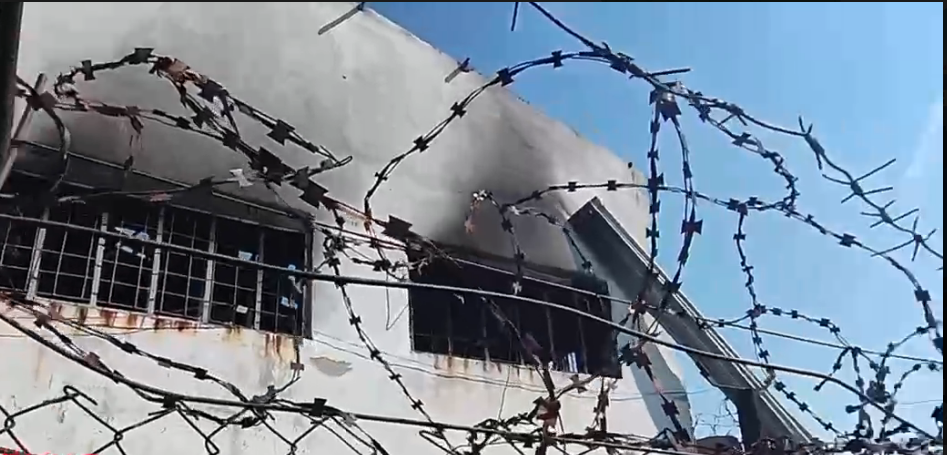
The windows have double bars, inside and out, with the first barrier a meter away from the window. Air enters only through a narrow slit. Every day at noon, prisoners are taken out for torture. Through that slit, the cell fills with the screams and moans of those taken that day.
“Enduring your own torture is easier — adrenaline helps you focus. The real psychological trial is the daily screams of your brothers. You can’t build immunity to it. It’s a sound that’s impossible to endure,” says “Bison.”
But even greater hell awaits inside the cell. For four months, he is locked face-to-face with Vadym Kovalenko, callsign “Kraken” — a chronic alcoholic and traitor to Ukraine, ready to sell his soul to the devil for a cigarette.
To use the toilet — located directly in the cell — one must follow a ritual: press a button, contact the guard, and obtain permission. Violating this rule leads straight to beatings. Everything is monitored by cameras, and every “unauthorized” action is punished.
“Kraken” uses this button constantly, deliberately condemning “Bison” to beatings whenever he hears Ukrainian spoken.
When “Kraken” attacks him physically, “Bison” fights back. After that, he himself spends two weeks covered in bruises after “disciplinary work” by the guards. The cellmate, however, never raises a hand again.
“This ‘Kraken’ is a former serviceman — everyone there knows about him. When I tell my brothers I shared a cell with him, they cross themselves. They say I deserve a medal for bravery — just for enduring him and not losing my mind,” says “Bison.”
In March, six months before release, “Bison” dreams of his mother. She says she won’t wait for him.
“So who is this important man?”
One day, the cell door opens and “Bison” is taken out — but without the usual shoves and baton blows to the back. The detention center must transfer people for stages or exchanges without visible injuries, so hope creeps in. But when his hands and face are taped, and he is placed alone in a prison van, fear sets in.
From the van, he is taken to the Novosibirsk airport. He is put on a charter flight to Chelyabinsk.
“They took me to the airport, where I spent the night in the prison van because, as I overheard, they couldn’t find a sober pilot over the weekend,” Serhii recalls.
Eventually, a pilot is found. And by charter flight, “Bison” is flown to Moscow. On the plane, the guards can’t figure out who this man is — so important that he alone is being transported to the Russian capital.
Later, it becomes clear that the prisoner exchange was delayed because everyone was waiting for Serhii Kovalov to be delivered.
“In Moscow, I’m transferred into a UAZ, we drive for about ten minutes, and then I’m led to the second floor of a transport plane. It was there, out of the corner of my eye, beneath the tape blindfold, that I saw the others — battered and worn by life,” says “Bison.”
Tension eases only over Belarusian territory when guards begin untying prisoners’ eyes and hands. But even then, the exchange nearly collapses: a civilian man attacks a guard with a sharpened object. He is thrown to the floor and beaten, and a warning comes over the radio that one more incident and the plane will turn back.
“Russians often recruited people from psychiatric hospitals, adding them to exchange lists as civilians. That man was one of them,” says “Bison.”


“I dream that it was all a dream”
Even after a successful exchange, the consequences of captivity do not recede. For five days, “Bison” cannot sleep.
“The greatest fear came in sleep, when it constantly felt like freedom was just a dream. I’d wake up in a cold sweat, with the sharp feeling that I was back in the cell in Biysk with that idiot,” he shares.
“Bison” returns from captivity, weighing only 42 kilograms — after exhaustion at Azovstal, where constant hunger compounded a severe wound. Yet on the second day after release, he buys himself a shawarma.
Almost immediately, he calls his sister-in-arms “Ptashka” to come cut his hair.
“Teeth knocked out, shaggy, overgrown — I wanted to look human again. And I also asked her to bring a piece of steak!” laughs “Bison.”


“Ptashka” insists that after such prolonged starvation, such heavy food is still not allowed — but she fulfills the request. And “Bison” enjoys the long-dreamed-of meat.
“The bullet from Mariupol that I carried through the entire captivity”
A few days later, he is already lying on an operating table at the Heart Institute — and not because of the steak.
“I only learned after my release that the bullet had traveled all the way to my heart,” he says.
The bullet became lodged in the myocardium — exactly in the areas where the tissue was scarred from previous surgeries. The surgically damaged muscle stopped the bleeding.

“My congenital heart defect saved my life!” laughs “Bison.”
“Dreams come true”
Serhii erects a monument on his mother’s grave. That dream proved prophetic. And he buys a house in a village.
“The plot is 14 sotkas! There’s access to the river from the garden. I’ve already picked a spot to dig myself a little pond!” he laughs.
“Bison” plans to demolish the old house to build a new one in its place. But he will preserve the site’s main treasure. Beneath the building are two basements, one of them an old Austrian, built from plinth bricks using a unique technology. Thanks to a special firing that adds egg yolks, the brick has become nearly eternal — drilling through it is three times harder than through modern concrete.
“Even a direct hit wouldn’t do anything to it! I’ll pour a new foundation on top — and that’s it,” he shares.
“Returning to the mission of the Hospitallers as a return to oneself”
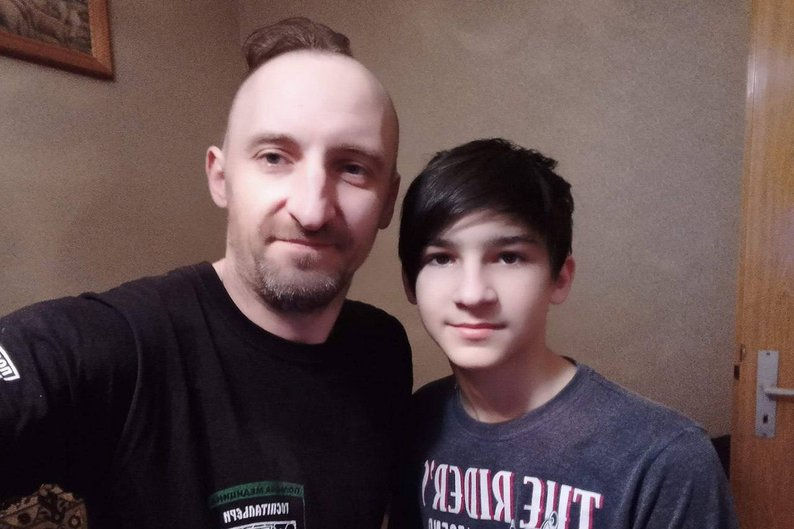
“Bison” continues his path in the ranks of his native battalion, now in a new but no less important role — working in the Hospitallers’ patronage service. He oversees treatment, rehabilitation, and social protection.
“To say that I’ve done enough and now someone else can do the rest — that’s not me. Man, look ahead — there’s endless work to be done!” Serhii Kovalov ensures dignified support for the wounded and assistance for the families of fallen sisters and brothers-in-arms. His current work is a logical continuation of the volunteer path he chose in 2014 — or perhaps even in the early 1990s, when he read a neighbor’s "Kobzar" by Shevchenko and fell in love with Ukraine, with its difficult yet life-affirming history. #Hospitallers #Paramedics #UkraineParamedics #HospitallersUkraine #HospitallersUK #HelpHospitallers #Ukraine #SupportUkraine #HelpUkraine #StandWithUkraine #HelpUkraineNow


Comments